When early signs of aging start to appear, many people find themselves choosing between a thread lift and a surgical facelift. While both treatments aim to lift and rejuvenate the face, they differ significantly in terms of procedure, downtime, cost, and results.
This guide breaks down thread lift vs facelift in a simple, side-by-side way, so you can understand which option may be better suited to your goals, lifestyle, and expectations.
What Is a Thread Lift?
A thread lift is a minimally invasive, non-surgical aesthetic treatment designed to lift and tighten sagging skin. Dissolvable threads (commonly PDO) are placed beneath the skin to provide gentle lift while stimulating collagen production.
Thread lifts are most commonly used on the jawline, cheeks, neck, and lower face, making them ideal for patients with mild to moderate skin laxity who want visible improvement without surgery.
A facelift (also known as rhytidectomy) is a surgical procedure that repositions deeper facial tissues and removes excess skin to create a more dramatic and long-lasting lift. It is typically performed under general anaesthetic by a plastic surgeon.
Facelifts are best suited for individuals with moderate to severe skin laxity who want the most comprehensive facial rejuvenation possible.
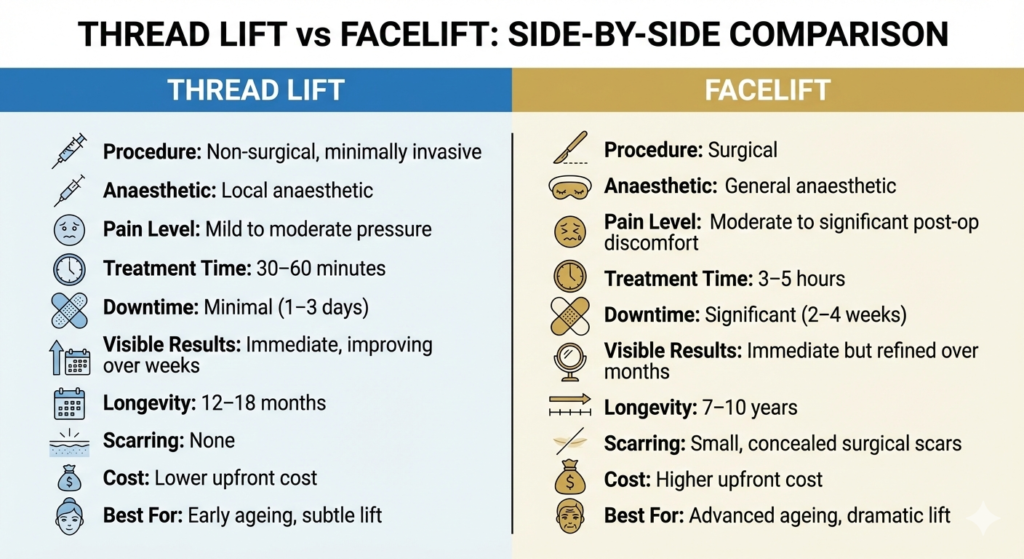
Thread Lift vs Facelift: Side-by-Side Comparison
Feature
Thread Lift
Facelift
Type of procedure
Non-surgical, minimally invasive
Surgical
Anaesthetic
Local anaesthetic
General anaesthetic
Pain level
Mild to moderate pressure
Moderate to significant post-op discomfort
Treatment time
30–60 minutes
3–5 hours
Downtime
Minimal (1–3 days)
Significant (2–4 weeks)
Visible results
Immediate, improving over weeks
Immediate but refined over months
Longevity of results
12–18 months
7–10 years
Scarring
None
Small, concealed surgical scars
Cost
Lower upfront cost
Higher upfront cost
Best for
Early ageing, subtle lift
Advanced ageing, dramatic lift
Type of Procedure
A thread lift is a non-surgical, minimally invasive procedure that uses dissolvable threads inserted beneath the skin to lift sagging areas and stimulate collagen production.
A facelift is a surgical procedure that involves repositioning deeper facial tissues and removing excess skin to create a more dramatic and long-lasting lift.
Anaesthetic Used
Thread lifts are performed under local anaesthetic, allowing you to remain awake and comfortable throughout the treatment.
Facelifts require general anaesthetic, as they are performed in a surgical setting and involve more extensive tissue manipulation.
Which Is More Painful: Thread Lift or Facelift?
A thread lift is generally well tolerated. Most patients describe sensations of pressure or tightness rather than pain, thanks to local anaesthetic.
A facelift, being a surgical procedure, involves more discomfort during recovery. Pain, swelling, bruising, and tightness are expected in the weeks following surgery and are managed with prescription medication.
Treatment Time
A thread lift usually takes 30 to 60 minutes, making it a convenient option that can fit into a busy schedule.
A facelift is a much longer procedure, typically lasting 3 to 5 hours, depending on the extent of surgery.
Downtime and Recovery
Thread lifts have minimal downtime, with most patients returning to normal activities within a few days.
Facelifts require significant recovery time, often involving 2–4 weeks of swelling and bruising, with full results settling over several months.
When Results Are Visible
Thread lift results are visible immediately, with further improvement as collagen production increases over the following weeks.
Facelift results are also visible straight away, but swelling means the final outcome becomes apparent gradually over several months.
How Long Do Results Last?
Thread lift results typically last 12–18 months, depending on skin quality, age, and lifestyle. Collagen stimulation can extend skin quality improvements even after threads dissolve.
Facelift results can last 7–10 years, making it the longest-lasting facial rejuvenation option.
Scarring
Thread lifts do not leave scars, as threads are inserted through tiny entry points that heal quickly.
Facelifts involve small surgical scars, usually hidden around the ears or hairline, which fade over time but are permanent.
Cost Comparison: Thread Lift vs Facelift
Thread lifts are significantly more affordable upfront and are often chosen by patients who want visible improvement without committing to surgery.
Facelifts involve higher costs due to surgical fees, anaesthesia, theatre time, and post-operative care — but offer longer-lasting results.
Which Treatment Is Right for You?
Choosing between a thread lift and a facelift depends on:
Your age and degree of skin laxity
Your tolerance for downtime
Budget and long-term goals
Many patients choose thread lifts as a preventative or transitional treatment. Others opt for a facelift when non-surgical options are no longer enough.
Book Your Thread Lift With Beyond
While we do not offer facelifts, we do offer non-surgical treatments including thread lifting. If you’re interested in a thread lift procedure, reach out today to book or talk to us.